
Why can't we stop comparing ourselves to others?
A self-reflective essay

I published an article earlier this week that surprised me.
Within 4 days, it had more views, comments, and shares than anything I'd written in over a year.
I should have been celebrating.
Instead, I found myself scrolling through other articles in my feed, watching their numbers climb higher than mine. That piece with 50,000 views. The thread with 500 comments. The post that went viral while mine just went... well.
It wasn't rational. My article was performing better than I'd ever hoped. But somehow, that success felt diminished by the existence of bigger successes elsewhere.
I was comparing my biggest win to someone else's even bigger win, and finding myself lacking.
This isn't new for me. I've tried all the right advice: measure yourself against your past self, focus on your own journey, celebrate small wins.
I know these things intellectually. But emotionally? That voice that whispers "but look how much better they're doing" always seems to sneak back in.
Turns out I'm not alone in this struggle. Research shows that as much as 10% of our thoughts involve comparisons of some kind. Ten per cent. That means one out of every ten thoughts you have today will be about how you stack up against someone else.
This fascinated me so much that I decided to dig deeper. Why do we keep doing this to ourselves? Are we the only species that tortures itself this way? Is this a modern problem, or something more ancient? And most importantly, can we actually stop?
This article is brought to you by Bechem’s Ghostwriting Services… one of the best newsletter ghostwriting services in the world. CLICK HERE to find out how I can help you build authority, influence, and revenue through a newsletter that your audience actually looks forward to.
Why does this happen?
1. The Psychological Foundation
In 1954, psychologist Leon Festinger introduced Social Comparison Theory, which suggests that we have an innate drive to evaluate ourselves, and we do this primarily by comparing ourselves to others.
This comparison works in two directions: we can compare ourselves to people who are
a. better than us, known as "upward comparisons" or
b. worse than us, known as "downward comparisons"
Upward comparisons often leave us feeling inadequate. Downward comparisons might boost our ego temporarily, but they don't lead to growth.
The cruel irony is that upward comparisons, while painful, are often what motivate us to improve. We see someone doing better and think, "I want that too". The problem is, when these comparisons become obsessive, when they shift from motivation to self-torture.
2. Your Brain on Comparison
At the neurological level, comparison is a reward system activation.
When we perceive a rewarding stimulus, dopamine is released from the Ventral Tegmental Area (VTA), acting on the Nucleus Accumbens, leading to feelings of pleasure.
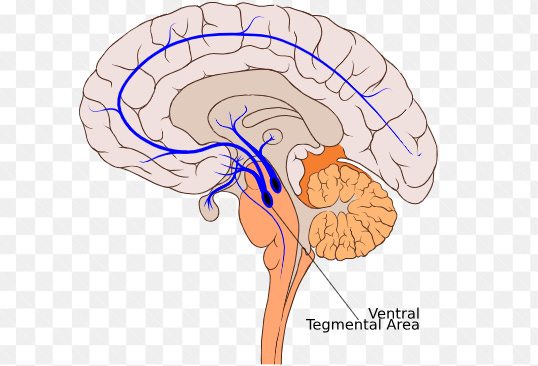
Interestingly, dopamine neurons display a reward signal indicating the difference between actual and predicted rewards. Your brain isn't just responding to your success but also constantly recalibrating based on what it expected versus what you achieved.
When you see someone else's success, your brain automatically recalibrates your own achievements downward. That article I was proud of suddenly felt ordinary because my brain had new data about what was possible. The dopamine hit I should have gotten from my success was diminished by the comparison.
Dopamine plays a critical role in mediating the reward value of social interaction, which means our social comparisons aren't just thoughts but also neurochemical events that literally change how rewarding our experiences feel.
3. The Evolutionary Wiring
From an evolutionary perspective, comparison was a crucial survival mechanism.
In small tribal groups, knowing where you stood in the social hierarchy meant knowing whether you'd get resources, protection, or mating opportunities. The people who were good at reading social dynamics and positioning themselves favorably were the ones who survived and reproduced.
Our ancestors lived in groups of around 150 people. If someone in your tribe had more food, better shelter, or higher status, that directly affected your survival chances. Comparison was a crucial information-gathering tool.
The problem is, we're still running this ancient software in a modern world. Instead of comparing ourselves to 150 people we know intimately, we're comparing ourselves to millions of strangers on the internet. Instead of competing for actual resources, we're competing for metrics that don't really impact our survival.
Our brains haven't caught up to the fact that someone else's success doesn't diminish our chances of success. In the tribal world, resources were zero-sum. In the digital world, they're often not. But try telling that to your amygdala.
How to Live With It
I don't think we can completely eliminate the urge to compare, and I'm not sure we should. Comparison has driven human progress for millennia. The key is learning to work with it rather than being enslaved by it. But how exactly do we do that?
1. I am begging you, read some philosophy
This might sound pretentious, but philosophy has given me more practical tools for dealing with comparison and life in general than any self-help book ever has.
Albert Camus, my favourite philosopher, wrote about the absurdity of human existence. The fact that we desperately want meaning in a universe that doesn't seem to provide any clear answers. In "The Stranger" and "The Myth of Sisyphus", he explores what it means to create your own meaning rather than seeking validation from external sources.
Camus suggests that once you accept the absurdity of existence, you become free to define success on your own terms. When I remember this, the fact that someone else's article got more views than mine becomes... well, absurd. Not meaningless, but not the ultimate measure of my worth either.
Nietzsche's "Thus Spoke Zarathustra" offers a different but complementary perspective. He writes about becoming your own person, creating your own values rather than accepting society's values. When you truly internalize this, comparison becomes less compulsive because you're measuring yourself against your own standards, not everyone else's.
For a more modern take, you can read Charles Taylor's "The Ethics of Authenticity". It examines how societal pressures shape our sense of self and offers ways to resist those pressures without becoming completely self-centered.
Krishnamurti's "Total Freedom" takes this even further, suggesting that true freedom comes from observing your thoughts without being controlled by them. When the comparison thought arises, you can notice it without being consumed by it.
2. Systemize, systemize, systemize
Creating systems sounds complicated, but it's not. A system is just a predetermined response to a predictable situation. Brushing your teeth when you wake up is a system. Checking your email at specific times rather than constantly is a system.
You can create a system for comparison too.
Mine is simple: when I catch myself comparing, I pause and ask three questions:
What am I trying to learn from this comparison? (Because, believe it or not, envy is one of life’s greatest teachers)
Is this comparison helping me improve or just making me miserable?
What would I do next if this other person didn't exist?
Then I act on the answer to question three.
I’m not pretending other people's success doesn't affect me. I’m just creating a circuit breaker that interrupts the comparison spiral before it takes over my entire day.
3. Have a mental model
The mental model that's helped me most is "Infinite Games vs. Finite Games", borrowed from James Carse's book.
Finite games are played to win. They have clear rules, defined endpoints, and winners and losers. Football is a finite game. Elections are finite games.
Infinite games are played to keep playing. The goal isn't to win but to continue the game as long as possible. Relationships are infinite games. Building a business you love is an infinite game. Creating art is an infinite game.
When I catch myself comparing, I ask: "Am I treating this as a finite game or an infinite game?"
If I'm treating my writing as a finite game, then yes, someone else's viral article means I'm losing. But if I'm treating it as an infinite game, as a lifelong practice of thinking clearly and sharing ideas, then someone else's success is just more evidence that the game is worth playing.
In infinite games, other players aren't competitors but fellow players who make the game more interesting.
In a nutshell
The deepest truth about comparison is that it reveals what you're really playing for.
When I felt diminished by other people's bigger numbers, it wasn't really about the numbers. It was about what I thought the numbers meant… recognition, respect, proof that my ideas mattered.
But numbers don't actually provide those things. Recognition comes from connecting with people who resonate with your work. Respect comes from doing work you're proud of. Proof that your ideas matter comes from seeing how they affect people's lives.
Those things can happen with ten readers or ten thousand. The comparison was distracting me from what I really wanted.
Friedrich Nietzsche wrote,
"You have your way. I have my way. As for the right way, the correct way, and the only way, it does not exist."
This is beyond relativism. It's recognition that life isn't a single-player game with a universal scoring system.
You can't stop the comparison thoughts from arising. They're part of how your brain works, part of how evolution wired you to navigate social situations. But you can stop letting them define your experience.
Become free enough to choose what you compare, how you compare, and what you do with the comparison once you've made it.
Because in the end, the only person you need to be better than is who you were yesterday. And the only game worth winning is the one where everyone gets to keep playing.
Thank you so much for reading. Feel free to share your thoughts in the comment section.
Mindcraft is a reader-supported publication. To support my work, consider recommending it to your network.
This article was brought to you by Bechem’s Ghostwriting Services… one of the best email newsletter ghostwriting services in the world. I help personal brands build their authority, influence, and revenue through a newsletter their audience actually looks forward to. Should I build yours too?
A lot of really interesting thoughts here. I liked the infinite versus finite games and the rundown of philosophy. This article felt like "if you're interested in this topic and you don't have time to do all the research, here, I've done some research for you..." I really liked that.
But I would love to hear more about your story and how you put this into practice. Just my 2¢... The idea of what we're trying to learn from comparing is fascinating. Have you learned anything interesting from comparing yourself?
Thanks for this list. I appreciate it.